It is not often that a young ERP provider raises $100 million in less than a year and becomes the most talked-about vendor in a room full of CFOs, but that is what Campfire managed to do.
CEO and CFO John Glasgow has built one of the fastest-growing new ERPs in the market. The company has drawn interest from public companies, AI startups and finance teams preparing for IPOs, even as many CFOs remain cautious about trusting a younger ERP with core accounting, audit readiness and reporting.
At the 2025 FATE conference last month in New York City, Campfire was among the most talked about vendors as those in attendance questioned how a company founded only a few years ago secured so much capital so quickly and whether its foundational accounting model could address long-standing frustrations with traditional ERPs. Glasgow says the rapid funding came less from investor hype and more from enterprise buyers demanding a balance sheet strong enough to eliminate any going-concern questions.
In a recent sit-down with CFO.com, Glasgow explained how Campfire is deploying its capital, why the company still operates with Series A discipline, how he manages the personal demands of running a fast-growing startup while serving as both CEO and CFO and what the future of his scope might look like.
John Glasgow
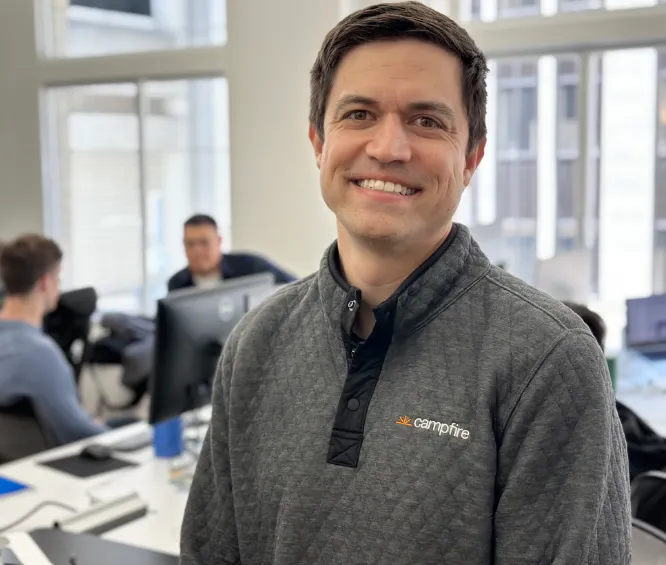
CEO and CFO, Campfire
Notable previous employers:
- Bill.com
- Invoice2go
- Adobe
- Union Square Advisors
This interview has been edited for brevity and clarity.
ADAM ZAKI: The company has grown fast and taken on a tremendous amount of money in a short period of time. What challenges come with that?
JOHN GLASGOW: It is a timely question because we raised $100 million in about 12 weeks; a $35 million Series A in June and a $65 million Series B in October. It was a very busy summer. I was planning to take my first vacation after the A. Clearly, that did not happen.
The main challenge is that we are incredibly well capitalized, so we have to be thoughtful about how we deploy capital without slowing growth through underinvestment. There are many ways to spend $100 million. The hard part is deciding how to spend it wisely.
Traditional venture funding gates capital around milestones. In our case, we are essentially ungated. We had not touched the Series A when we raised the B. Investor demand was high, but the real driver was our customers. After we announced the A, companies with $500 million to $1 billion in revenue reached out. They told us the product was perfect, but they needed to see us so well capitalized that going concern would never be a question with their auditors or boards.
So the additional capital was really for those lower enterprise and public company customers. We now have public companies and IPO readiness customers on Campfire, along with fast-growing AI companies like Replit and Decagon. For them, the raise solved a procurement and risk issue more than a runway issue.
“There are many ways to spend $100 million. The hard part is deciding how to spend it wisely.”

John Glasgow
CEO and CFO, Campfire
Operationally, we still behave like a Series A business. The main exception is that the extra capital allows long-term investments. One example is our foundational model, the large accounting model. Large language models have been terrible at accounting, so we built our own and hired an AI engineering team in San Francisco. That investment came directly from the Series B.
For everything else, we operate as a Series A. Even though we have [quintupled] headcount in the last four to five months, that growth has been funded from the Series A capital.
You can’t hold the dual role of CEO and CFO forever. If you hire a CFO, which financial responsibilities would you want to keep under your control?
As the founder, I like to stay involved in every function. The whole company is here in San Francisco with me, in the office with me, five days a week. Some days I sit with engineering. Some days I sit with go to market, customer success or HR. I want to understand what is going on across the whole business.
I spent 15 years in finance. The founding story of Campfire is that I was frustrated with our ERP. It was holding us back from a financial reporting standpoint. There was too much manual work. For us to deliver on the vision of serving my peers, my fellow finance leaders, I want to stay close to finance.
Parker Conrad at Rippling famously still runs the Rippling instance. He wants to always be able to run it. I feel the same way. We run Campfire, and when we go public on Campfire, I want to still be running the Campfire instance. There is a lot of automation and AI in Campfire. When we were fundraising, I was dropping diligence requests into our AI, and it was kicking out diligence reports and everything investors needed.
So, I want to stay customer number zero. That mindset is critical. I would love to always be involved in finance. At some point, we will need to hire a CFO as we grow, because there are other areas of the business I will have to spend more time on. But this is my happy place.
I love going to dinners and virtual events like the one we spoke at and talking with finance peers. Staying close to the work is how we make sure we build an incredible product for them. But as we scale, yes, I will want to stay involved, but I will take a step back from being the true CFO.
How do you make sure the sales experience matches the implementation experience? Many ERP vendors struggle with that gap, where sales is polished but onboarding becomes a challenge. How did that shape how you built Campfire?
We use both implementation partners and an in-house team, and we try to bring our in-house implementation team into the sales cycle whenever possible. They walk prospects through the actual plan, so the customer sees the real delivery team up front.
I also stay very close to every customer. I am in every customer Slack channel, watching how onboarding is going and making sure the experience is consistent from what the sales team promised through go-live. That closeness matters because this is a trust sale. If onboarding is not world-class, nothing else works. We would not be growing this fast if implementation did not meet expectations.
We have built the company around that principle. We want credibility with our customers, so we invest heavily in implementation quality. We also require a customer reference call for almost every deal. Prospects hear directly from a live customer about what life is like after signing. That creates accountability for us and gives prospects confidence that the experience will match what we present in the sales cycle.
Attendees at FATE raised a big concern about cloud ERPs. If an update or integration breaks something, the customer often ends up responsible. Can customers negotiate shared responsibility with Campfire, and how do you address that risk?
I love going deep on this topic. When I was at Adobe, our product was similar to NetSuite in the sense that you could write custom code directly into the product. NetSuite allows this through SuiteScript. Once a customer or a third party writes custom code into the ERP environment, the customer becomes responsible for breakage because they introduced code that the vendor cannot control. That is why in the legacy ERP world, updates can break workflows, and the burden falls on the customer.
“We take full ownership of making sure the platform does not break when we ship updates. Customers do not absorb that risk because they are not injecting code into the core system. They get the flexibility they need without the fragility that comes from modifying the ERP’s internal code base.”
John Glasgow
CEO and CFO, Campfire
Campfire is built differently. We use a modern multi-tenant SaaS model where you cannot write custom code into Campfire. You build on top of Campfire or around it, similar to how Shopify works. Developers build apps around Shopify, not inside Shopify. Because of that design, Shopify owns the stability of its platform. We take the same approach.
So, with Campfire, we take full ownership of making sure the platform does not break when we ship updates. Customers do not absorb that risk because they are not injecting code into the core system. They get the flexibility they need without the fragility that comes from modifying the ERP’s internal code base.
From a security standpoint, we are SOC 1 and SOC 2; we handle data encryption and all the controls you expect. If a customer has a weak password and someone gets into their environment, that is on them. But if it is about platform stability, update integrity or core system reliability, that is on us. That is one of the biggest architectural differences between Campfire and the legacy ERP vendors CFOs are used to working with.
What is the single biggest goal for Campfire in 2026, and if it is growth, how do you expect to execute it?
We are on track to 20x revenue this year, which is incredible velocity, so maintaining that pace is important. But the specific goal I am most focused on is supporting more IPOs on Campfire. We already have many customers in IPO readiness and many fast-growing AI companies using Campfire.
What I want in 2026 is for the IPO markets to stay open and for more companies to go public while running their accounting, SOX, SEC reporting and audit readiness on Campfire. That is something I track very closely. Whether a customer is working with their auditors or building out their SEC workflows, I want Campfire to be the system that takes them through that stage.
So yes, growth is important, but the deeper goal is proving that Campfire is the ERP of choice for companies on a public company trajectory.
How do you manage stress and keep balance in your personal life? And when you face a question that you can’t answer but probably should be able to, who do you turn to for guidance or mentorship?
During my Y Combinator days, there was a bingo night where one of the squares was to find someone who was a parent, and I was one of the only ones. Being a parent has given me perspective.
Even though we are in the office five days a week, I make sure I am home to see my daughters before they go to bed. When travel makes that impossible, being with my wife, kids and our dog is what grounds me. That time is how I decompress from the pace of building a company.
My oldest daughter is the same age as Campfire. In the early days, I was fundraising with baby bottles at 4 a.m. My wife has become my silent cofounder. All the big decisions run through the big boss at home. I tell other founders, do not go it alone. Whether it is family, friends or mentors, you need people who will be there for you through the entire journey. It moves fast, and it can be intense, so support matters.
When I need guidance, I turn to my identical twin brother. He is also a founder, and his company is ahead of us in its journey. His perspective has been incredibly helpful because he is close enough to understand what I am dealing with but far enough ahead to know what is coming next. My advice on mentorship is to find someone who is just a few steps ahead of where you want to go, whether you are a CFO, a controller or a founder. That is the most useful guidance you can get.