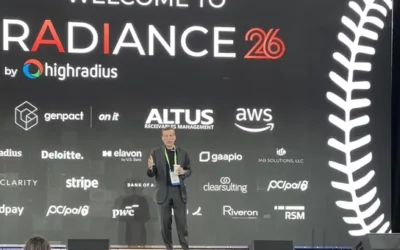
After years on the front lines of well-established companies like Google and Adobe, Razzak Jallow says he’s happy to be back in the startup world at California-based accounting software firm FloQast. Though he’s traded the relative certainty that such industry giants offer, he relishes the challenges of a young business.
“I always make the comparison that being at a startup is kind of like being on a battleship: You never know what’s happening next,” he says. Working in a Google division, on the other hand, is “a little bit more like being on a cruise ship.”
These days, of course, the extent to which FloQast is still a startup is debatable. Founded in 2013, the accounting software company now employs about 800 people and has raised over $280 million from external investors to date. It’s also something of a pioneer in B2B marketing, having recruited the likes of Cheri Oteri, Kate Flannery and other big-name actors in a comedy series called “PBC,” accounting-speak for “prepared by client.” A passion project of FloQast’s CEO, the show went on to earn mainstream recognition and ran for two seasons, with a third on the way. The larger aim, Jallow says, is to show that accounting can be “pretty cool and funny.”
The accounting industry’s well-known talent shortage is, of course, no joke. And despite advancements in automation and other emerging technologies, Jallow says that all signs point to increasing demands for accountants in the years ahead.
In an interview with CFO.com, Jallow talks through the nuances of leading a company that bills itself as “by accountants, for accountants” at a time when the profession faces serious talent shortages. He also makes the distinction between probabilistic and deterministic artificial intelligence and explains how he aims to differentiate the firm in an oversaturated tech market.
Razzak Jallow
CFO, FloQast
First CFO position: 2021
Notable recent employers:
- Adobe
- Apple
This interview has been edited for brevity and clarity.
DAN NIEPOW: PBC, FloQast’s mockumentary series, has certainly generated plenty of buzz on the internet. How’s the reception been in the accounting industry itself?
RAZZAK JALLOW: That was a passion project of our co-founder and CEO Mike Whitmire, and I think it’s resonated in a lot of ways. It’s shown customers that we really do get accountants, and we really are former accountants here. If you look at our customer-facing employees, the vast majority of them are former accountants. A lot of our external auditor friends who’ve seen the show have said, ‘Yep, that feels like an Office-sized version of what happens.’
Any plans to keep the series going after the third season?
I think season three wrapped up in a good spot. Never say never, but there’s nothing in the works at the moment.
“Accounting is not going away. … If you go back and look, calculators didn’t make accounting go away. Spreadsheets didn’t make accounting go away.”

Razzak Jallow
CFO, FloQast
Your company prides itself on being “by accountants, for accountants.” Today, though, we’re all seeing a shrinking talent pool in the field. How are you thinking about maintaining the talent pipeline that is such a vital part of your workforce?
There are two aspects to it. First, there’s the reality of what’s happening right now. There are fewer and fewer people entering the accounting profession. And at the same time, there are more and more people reaching the end of their careers and retiring. Add to that the fact that business models are getting more complex.
But the demand for accounting talent is actually skyrocketing. We see our opportunity to step in and bridge some of that talent gap with our technology and automation, whether that’s workflow automation or AI automation. We really see AI tooling as the next step in the profession. Accounting is not going away. None of these new tools will work without an accountant helping develop and run them.
If you go back and look, calculators didn’t make accounting go away. Spreadsheets didn’t make accounting go away. There’s been a really interesting analysis showing that the demand for finance and accounting roles actually went up with the invention of the spreadsheet. With AI tooling and increasing demand for the job, we’re anticipating that people will re-enter the profession a bit more.
There are fears among some investors and analysts about a forthcoming AI bubble. The financial technology market itself may be approaching a time of oversaturation, too. How are you thinking about differentiating your company today?
I’d start by talking through the difference between probabilistic AI and deterministic AI. If you look at go-to-market AI, probabilistic models are fine in some cases. If you can automate some outgoing emails and they’re 85% accurate, great, let’s do it.
Accounting is a case where tools need to be 100% accurate. It can’t be probabilistic. We can’t have the AI deciding to do the same thing two different ways. Most of the AI you’re seeing in accounting right now actually isn’t workflow automation or deterministic.
That’s where we’re spending most of our time. We’re building AI for accountants specifically. What that means is we have an AI tool that can grow and evolve with the accountant, but the actual output of the workflow it’s automating is a deterministic model. It’ll give the same answer every time, and accountants can trust that the automation is working correctly, predictably and repeatedly. I think that’s where we’re a little different.
I’d add that the requirements of accounting are very different. Things need to be auditable. Most of the mainstream AI solutions out there don’t have any plan on how they’re going to be auditable.
What’s the best piece of professional advice that sticks with you today?
When you’re early in your career, take the job that’s going to give you the most experience at the best company with the best boss, and prioritize those things over a few $1,000 more in cash. There’s a minimum cash you’ll need, but once you’re above that minimum, prioritizing those other things is important in the long term.