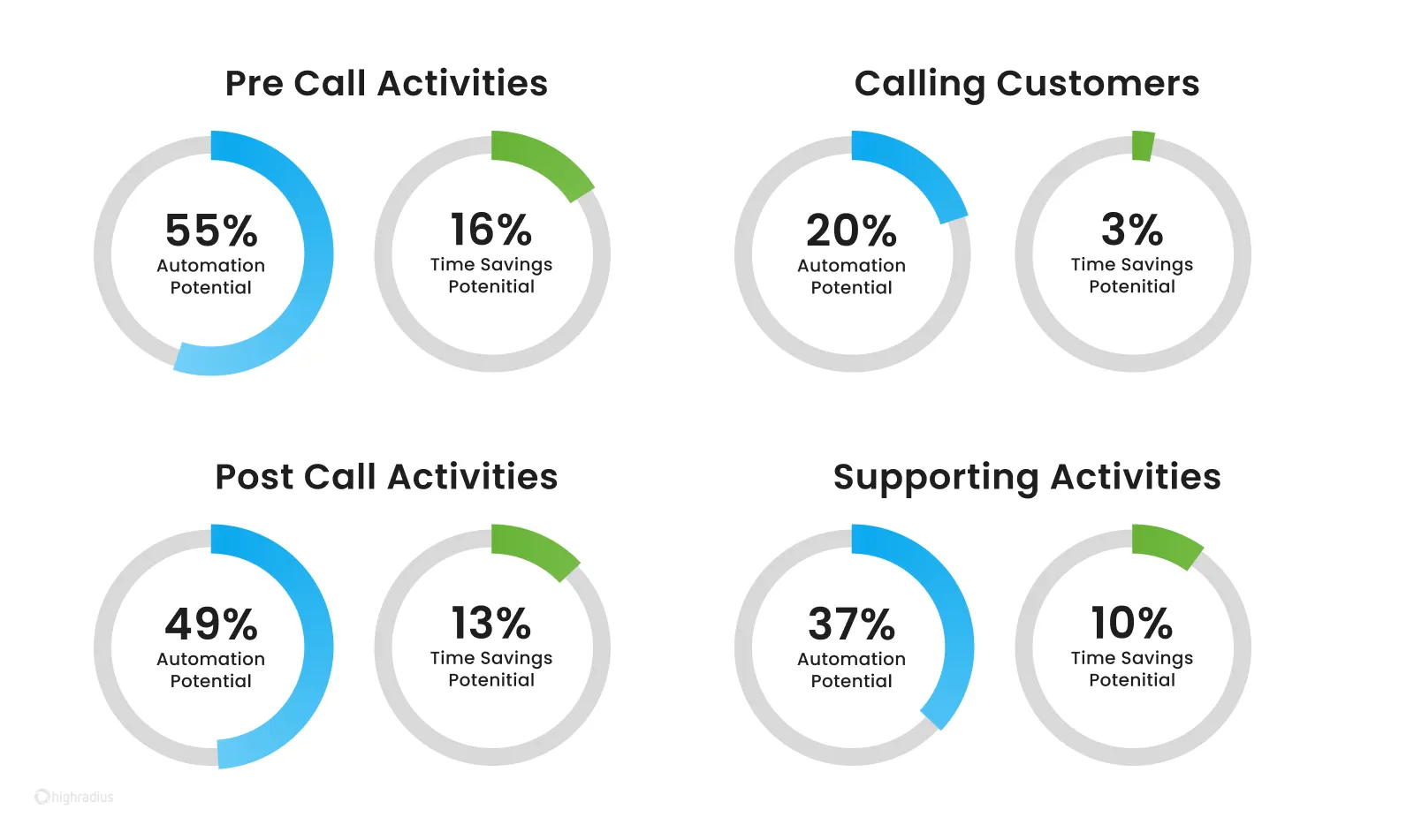
A collection analyst’s time is spread across 11 key tasks, which can be simplified into four activities: pre-call activities, calling customers, post-call activities, and supporting activities.
Across these activities, there’s an average automation potential of 40%.
Pre-call, post-call, and supporting activities showed the highest automation potential, making them the best candidates for AI augmentation.
Get industry-wise trends: “Talk to an expert!”
Collections management is 80% math, 20% language problem
When you strip away the jargon, collections management is fundamentally a “math optimization problem”.
The “math” comes into play when you analyze payment histories, prioritize accounts, and predict the most effective outreach strategy.
It’s about deciding which customers are most likely to pay after a reminder or scheduling follow-ups across time zones. These are statistical and logical problems that machines handle exceptionally well.
But collections isn’t free from human interactions. That’s where the 20% language component comes in. Because you still need to communicate effectively.
This includes drafting personalized emails, summarizing call notes, or resolving disputes professionally. Here, large language models (LLMs) work perfectly.
In short, get the math right first, and the language will follow naturally!
A day in the life of a collections analyst
Collections management is about making these three decisions accurately:
- Who to contact
- When to contact
- How to interact
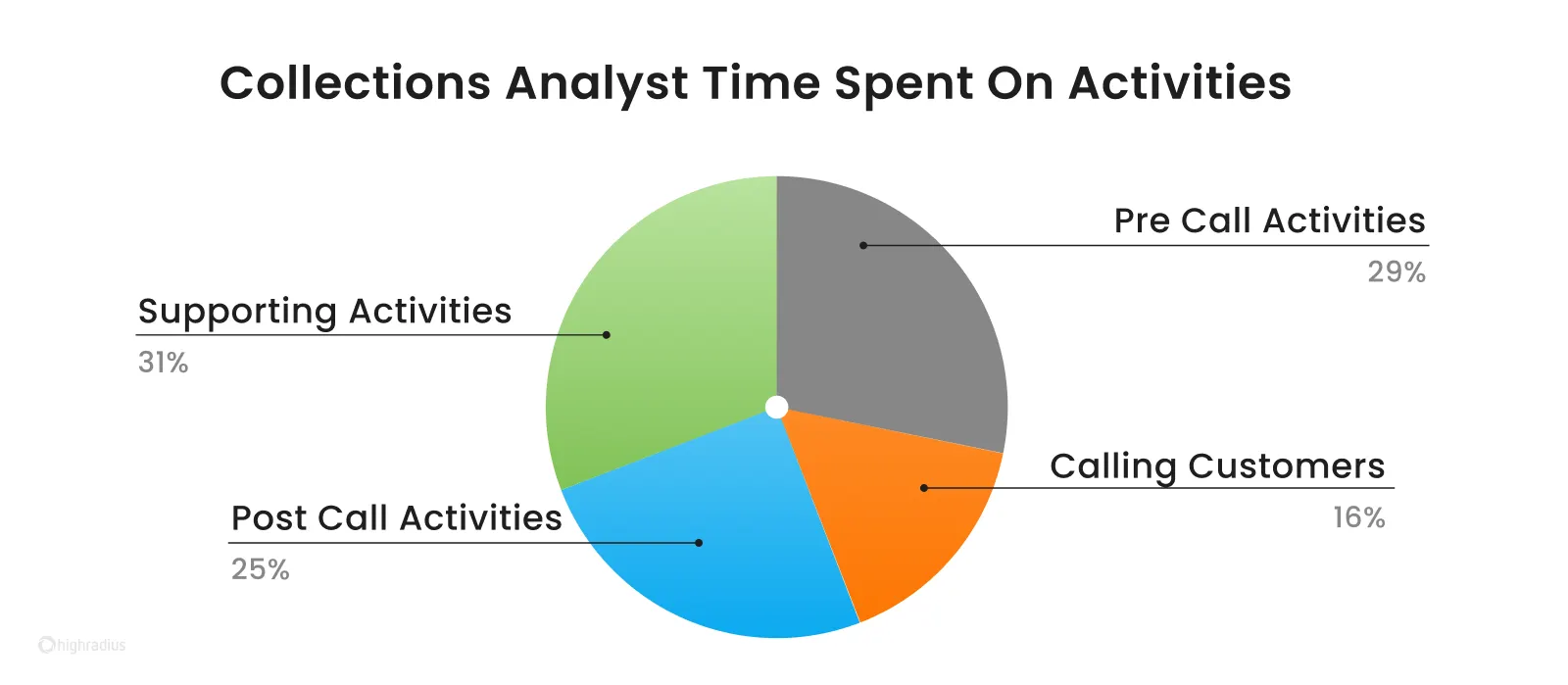
And, if you break down a collections analyst’s day, it revolves around four core activities.
- 29% Pre-call activities: Customer identification, account research, sending standardized/bulk emails
- 16% Calling customers: Direct phone conversations with customers
- 25% Post-call activities: Follow-up emails, reporting, and analytics
- 30% Supporting activities: Logging, collaboration, portal management, dispute resolution, and other ad-hoc tasks
Of these four activities, pre-call activities offer the highest automation potential at 55%. Post-call activities and other supporting activities follow closely behind. Customer calling remains largely manual, with the least automation potential.
Let’s expand more on these opportunities.
Opportunity #1 (Pre-call activities): Save 16% time via automated dunning, worklist prioritization, and customer research
Pre-call activities consume 29% of an analyst’s time. The average automation potential here’s at 55%.
Automation potential and time savings:
- Customer prioritization: Analysts spend about 12% of their time deciding which customers to contact first for payments. With 68% automation potential, AI can save up to 7% of their time.
- Account research: Analysts spend about 7% of their time collecting account details like payment history or contact info before calling customers. With 44% automation potential, you can save up to 3% of their time.
- Bulk reminder emails: Analysts spend about 11% of their time sending payment reminder emails. With 57% automation potential, you can save up to 6% of their time.
Automation opportunities:
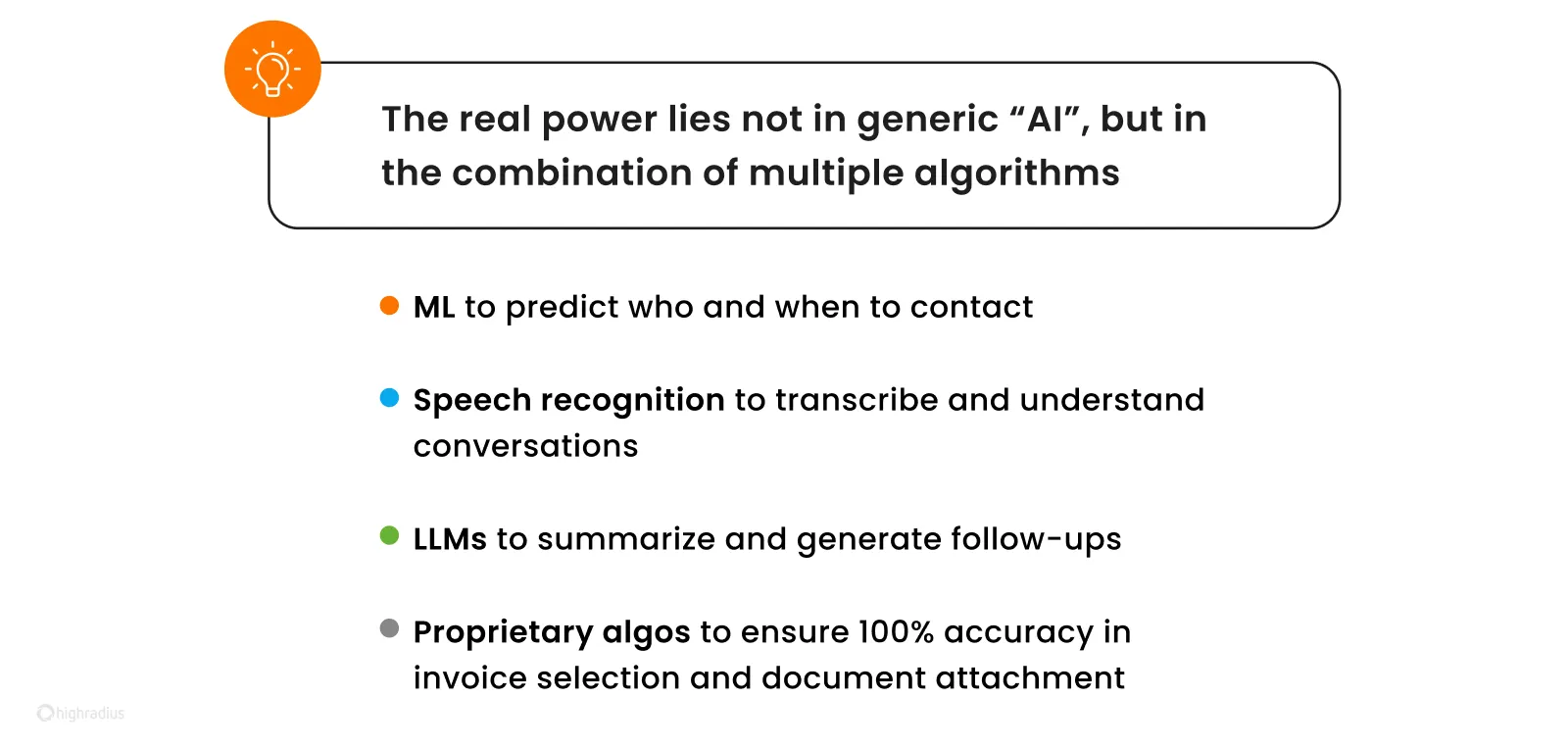
- Use ML to rank customers and create prioritized worklists by analyzing payment history and past-due amounts. Predict late payments and recommend follow-up actions.
- Use ML, LLM, and Proprietary Algorithms to schedule bulk emails with embedded payment links for easier payment journeys.
- Use LLM to summarize past-due data and gather customer intelligence, including payment behavior and AR health. AI-recommended actions can help analysts send proactive follow-ups.
Together, these agents free analysts from repetitive prep work, allowing them to focus on strategic customer outreach. Reduce AP Function cost by 40%: Explore HighRadius Accounts Payable Suite.
Opportunity #2 (Post-Call Activities): Save 13% of time via automated customer emails (customized), reporting, and analytics
Post-call activities consume 27% of an analyst’s time. The average automation potential here’s at 49%.
Automation potential and time savings:
- Customized outreach for past-due reminders: Analysts spend 21% of their time creating personalized emails. With 49% automation potential, you can save up to 10% of their time.
- Reporting and analytics: Analysts spend 6% of their time creating dashboards and analyzing data. With 49% automation potential, you can save up to 3% of their time.
Automation opportunities:
- Use GenAI to sort emails as collections or non-collections, summarize long email threads, and compose emails with attachments.
- Use pre-defined templates for reminders and notices with embedded payment info, so collectors don’t have to write them from scratch. Include payment links with the email.
By automating email workflows and reporting, teams reclaim hours of productive time each week and respond faster to customer needs.
Opportunity #3 (Supporting activities): Save 10% of time via automated dispute prevention, post call notes taking, and AP portal invoice tracking and upload
Supporting activities consume 27% of an analyst’s time. The average automation potential here’s at 37%.
Automation Potential & Time Saving Opportunities:
- Activity logging and updates: Analysts spend about 15% of their time recording activity updates such as system notes, P2Ps, and reminders. With 43% automation potential, AI can save up to 6% of their time.
- Dispute prevention, inter-team collaboration, AP portal activities: Together on these activities, analysts spend about 13% of their time. With a combined automation potential at 42%, AI can save up to 4% of their time.
Automation opportunities with AI:
- Perform two/three-way matching of invoices and POs across ERP, billing, and AP Portals. Identify trends and highlight areas that can be fixed to avoid disputes.
- Use RPA, Proprietary Algorithms, and Operator AI to automate the upload and tracking of invoices across diverse AP and customer portals, minimizing manual effort and integration time.
How HighRadius applies AI to collections management
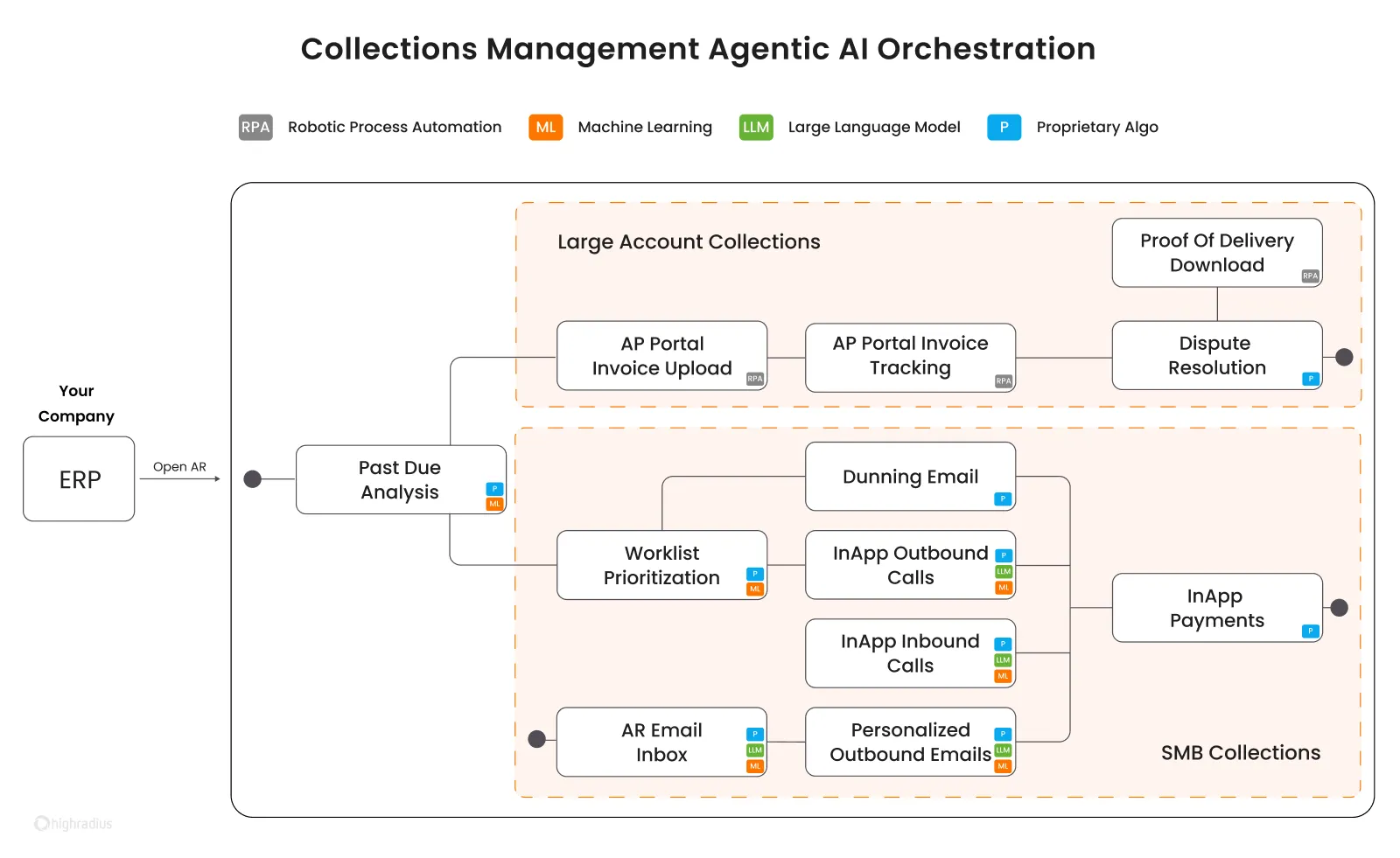
HighRadius automates collections tasks, saving 42% of analysts time on average.
15 AI Agents upload invoices to AP portals, prevent disputes, and generate personalized worklists for every collector. The agents use advanced ML, proprietary algorithms, RPAs, and LLMs to automate repetitive work.
Algo accuracy reduces past dues by 20% and increases collector productivity by 30%.
Leading brands like Red Bull, DXP, and BSN Sports trust HighRadius AI to maximize working capital, shrink past-due volumes, and deliver measurable DSO gains.
For more info visit https://www.highradius.com/resources/value-creation/.